


The following is part of a series of artist conversations that 2dcloud has commissioned. Many of these will be divided into 2 parts online and later collected into our various print publications. By signing up to our substack House on Fire you can catch them first. By becoming a paid subscriber you will receive an entire season of comics and books in print each year mailed directly to you in one burst.
This conversation between Katie Lane and Jason Overby wrapped earlier in the year. Katie Lane is the artist and author behind the Ignatz nominated Girls Gone Wild series (2dcloud), author of Rheme (Canton Editions), Single Camera Sitcom (Comics Blogger Books) as well as the co-editor of Altcomics Magazine 7 (2dcloud), and co-editor publisher of Bernadette Magazine. Jason Overby is a wildly undersung cartoonist, creator of Record, Jessica, Exploding Head Man, and co-creator of the comic forum Co-mix / comets comets (2009-2011).
I want to thank Katie and Jason for taking part. Please enjoy :)
Katie
So, how do you want this to go? I actually didn’t send you what I thought I was going to send you. So I’m sorry about that.
Jason
That’s okay. I don’t know. We can just talk. Did you have some questions that you were thinking you wanted to ask of me?
Katie
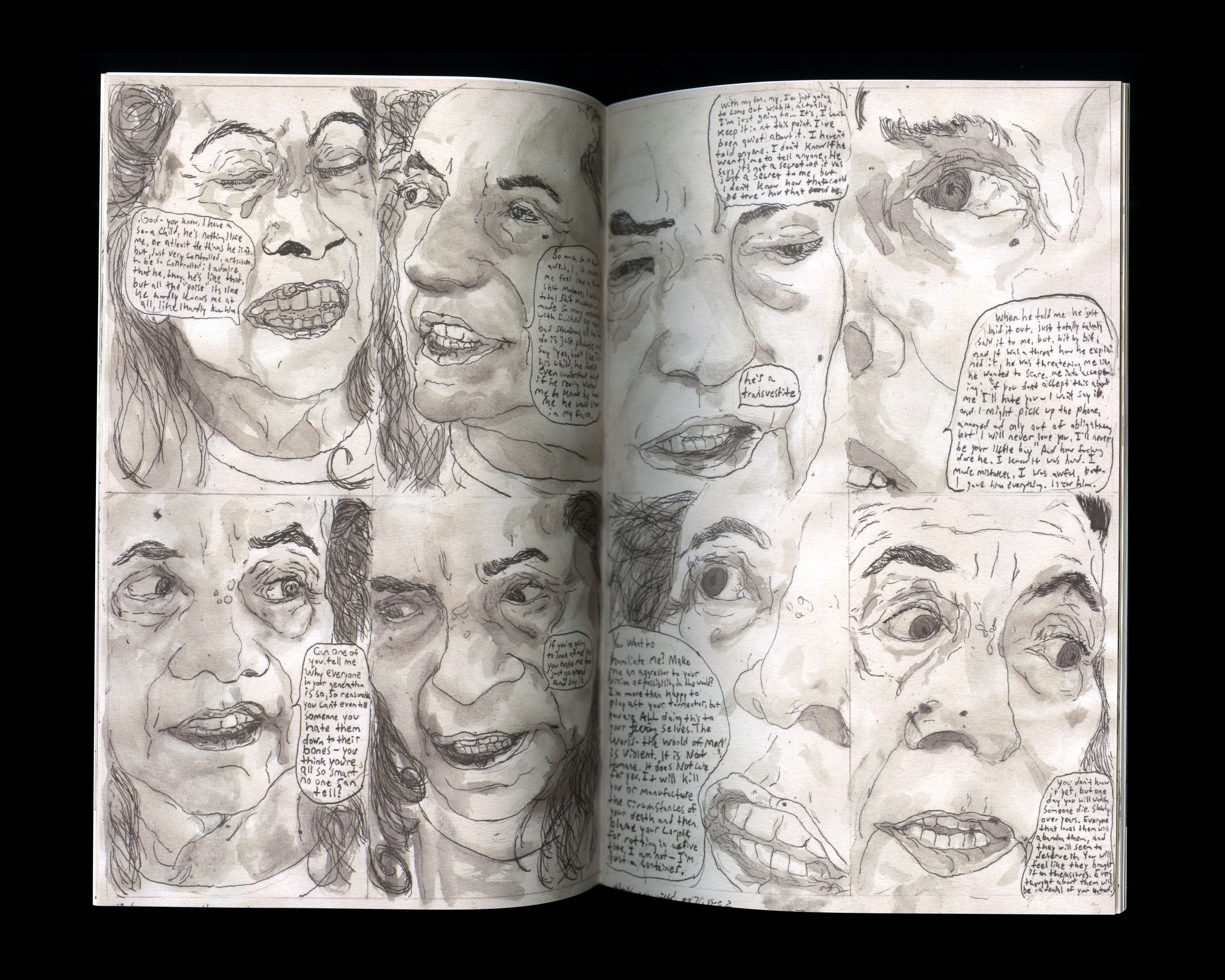
Mm. Yeah. I mean, there’s a few ideas I have or things that I’m interested in, and I think I could go about talking to you about, like the first one is: how did you come about this? Because your style is very textual. It’s very much about, or it seems like to me, it’s very much about the organization of text, which
Jason
Mm-hmm.
Katie
maybe all comics are, but it is in this self-reflexive way where you’re drawing attention to the text or estranging the text from where it’s supposed to be, like you’ll be writing words in a gutter or something like that,
Jason
Right.
Katie
just like really using all of the kinds of conventional comic tools. But instead of exclusively offering an image-forward perspective, you foreground the text. So how did you come about that or when did you start working in this style?
Jason
That’s a good question. I don’t know for sure. One thing I’ll say is, I feel like I am more comfortable writing than drawing.
Katie
Uh-huh. Yeah.
Jason
I went to art school, and, I don’t know, art school is not necessarily about technical proficiency in any particular medium. And I think, maybe, drawing is a little more stressful for me than writing. So maybe that’s part of it. Part of it, I was just, I rediscovered recently... So, when Understanding Comics came out, I feel like that was a really big book for comics, for people in comics at the time. For me, it was a pretty big book. I thought it was cool as a work of theory. I think that post Understanding Comics, particularly, maybe not immediately, but there became this kind of mode of making comics that became the accepted mode of doing it that seem to be related to Understanding Comics, the book, that was really, like, show don’t tell. That was about creating, it was almost like a play or something where there are characters that are shown mostly full-bodied in an environment, and there wasn’t often a lot of extra-diegetic information. The only words were dialogue, things like that. And that became a pretty dominant mode of indie comics around the turn of the millennium. There was an article around that time in the Comics Journal from a cartoonist named Dylan Horrocks that was kind of against that or just questioning that idea and questioning the idea of comics as a “medium” that is separate from other media and that has inherent properties that are comics-specific. You definitely heard at the time, and you still hear people saying “that’s a pure comic” or, you know, whatever. There were a lot of comics - there was a book that came out in 2000 called Comix 2000 that was just image-only comics by a lot of international cartoonists, cartoonists from around the world. The thing of the book was that you weren’t allowed to have text in it, which was partially because it was international, so there were no language barriers but it also felt related to this more formal idea. And so the Dylan Horrocks’ piece was just, I don’t know, questioning what is a comic, and I thought that that was interesting, and so when I finally... I grew up liking comics, but when I finally started feeling comfortable enough to make comics, I really was into questioning a lot of the assumptions of what constituted a comic. And, for me, some of it is just the kind of affectations that have developed around comics, like panels, word balloons, thought bubbles, like those types of things. And then the other part, I think, is related to using words, which is rhythm. I think one thing that is interesting to me is the rhythm between panels and how you structure things so that people experience a certain idea or set of words in a particular sequence and the way that they might read that to themselves. So, I don’t know, those were probably some of the reasons. I’m not sure any more specifically than that.
Katie
No, I mean, I still think that that is a relevant. I mean, it’s like a relevant problem,
Jason
Yeah.
Katie
or a perennial problem maybe. In comics where it is this kind of like - there has always this, been flow. I think of like work that’s more graphic. And then the image, the text becomes like an image
Jason
Right.
Katie
in a kind of a specific way where it’s like, the text, the speech box is basically just to, you know, redouble the visual
Jason
Right.
Katie
material, or it never undermines it or if it does undermine it, it does in this way that’s kind of explicit or obvious, so you can really be aware that it’s being undermined.
Jason
Right. It’s almost like irony as opposed to maybe they exist as separate channels of information, and they’re providing you different information. I think one thing that’s really interesting about the comics you make is the way that you are using text as a visual element because the
Katie
Hmm.
Jason
writing is very handmade, not like a lot of older cartoonists or people who are more immersed in comics history, they strive to create something that looks almost mechanical, but not mechanical,
Katie
Yeah.
Jason
they don’t want to use a font, but
Katie
No,
Jason
but
Katie
yeah.
Jason
yours feels more human, and I think
Katie
Yeah.
Jason
that’s cool.
Katie
No, I mean, for me, it is about the, I don’t know... I mean, I feel like my lettering has been kind of controversial in some people’s like minds insofar as I talk to people about it and they’re like, why is it like this or something like that?
Jason
Right.
Katie
And yeah, it’s the human voice is the effect I’m going
Jason
Yep.
Katie
for. It has to have this like fingerprint quality. Like, unique, I guess is what I mean.
Jason
Totally.
Katie
So yeah, there is like, well, because in comics, I mean, in your comics, I think like the fun, there is a textual consistency.
Jason
Yeah.
Katie
To a certain level, I don’t know when exactly you started doing this exact kind of style that you do now or, you know, there are these like kind of large letter-forms that are relatively consistent, and it seems like you’re working those, it’s like you must be laboring over that, for most of the work of the page is like working on those things.
Jason
Yeah, I
Katie
Maybe.
Jason
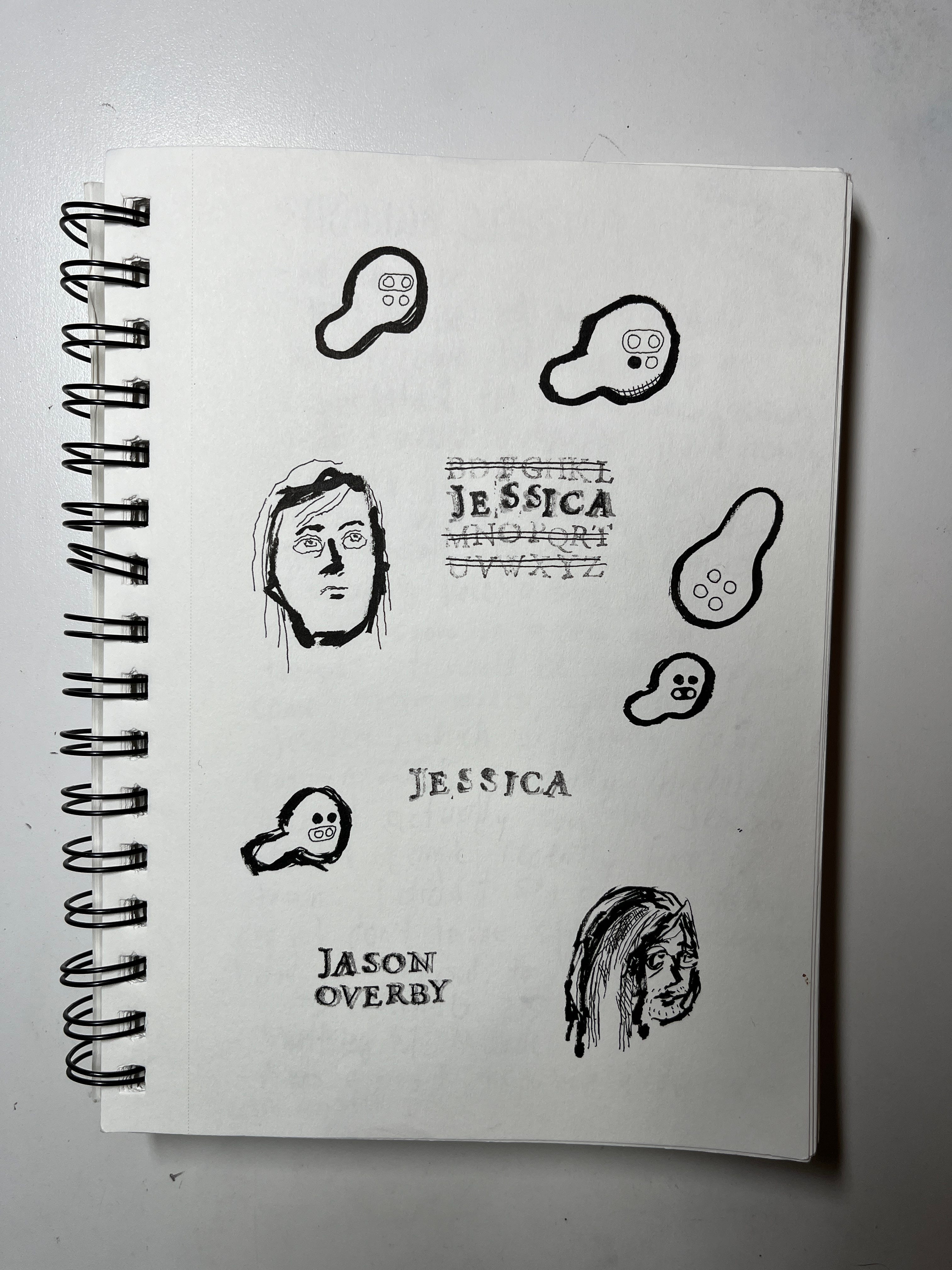
think, with certain things, definitely that’s true. Like for a while, I was, and I still do this sometimes, like, I use this set of rubber stamps. I got like over 20 years ago, but these rubber
Katie
Yeah.
Jason
stamps for letters that have, you know, part of the charm is that since I’ve had them for so long, they’ve actually degraded through their use, and they were pretty crummy to begin with, but there’s some kind of nice aspect to that.
Katie
Yeah.
Jason
I think I liked that it’s kind of human but also mechanical and also kind of a way to remove myself, my persona. But then the opposite is actually drawing letters in a way that’s pretty specific, that is more decorative,
Katie
Yeah.
Jason
maybe subtly questioning the idea of letters as just a way to convey textual information, but instead, highlighting the fact that letters themselves are a visual element in the comic. I think I was probably always doing that to some degree, and I’ve made comics where some of the idea was questioning words themselves as concepts,
Katie
Yeah.
Jason
showcasing in a drawing, instead of drawing a tree, having the word “tree” or something like that,
Katie
Yeah.
Jason
as a way to kind of suggest that the boundaries between things in the world are relatively permeable and not as hard-lined as they might be in a drawing or especially in a comic type drawing. Using words in that way I think is interesting too.
Katie
Yeah, I remember I was getting really bored of drawing with my pen
Jason
Mm-hmm.
Katie
or something, and I was just kind of frustrated with the way I was drawing, and I was talking to Blaise about it, and I was like, you know, it doesn’t make sense to draw with a pen
Jason
Mm-hmm.
Katie
in the
Jason
Yeah.
Katie
way, I don’t know, it’s
Jason
Totally.
Katie
because there aren’t lines in the world or black, like hard demarcations of forms is not the way that, like, it’s kind of the way that perception
Jason
Right.
Katie
works, you know, the way that we conceptualize objects to hold shapes
Jason
Yep.
Katie
and then naming them or whatever, but there isn’t a clean visual, like, light, as far as the light is concerned.
Jason
Right. It’s a vestige from illustration in the past or comics in the
Katie
Yeah.
Jason
past or whatever.
Katie
Yeah, and I think that I still always find that kind of confusing or something, and I don’t really know where to go with that. But I do understand that idea. I mean, I had this idea when I was doing this comic called Single Camera Sitcom where the whole thing was like digital collage
Jason
Mm-hmm.
Katie
basically, and I started to get really tripped out by the fact that the letters that I was putting into it were also images or something and that they have the same quality as an accumulation of pixels on a screen or
Jason
Yeah.
Katie
something, but since we relate to them differently in a sensational capacity. I thought
Jason
Right.
Katie
that was a big realization for me at a certain point.
Jason
Yeah, it’s kind of
Katie
Uh
Jason
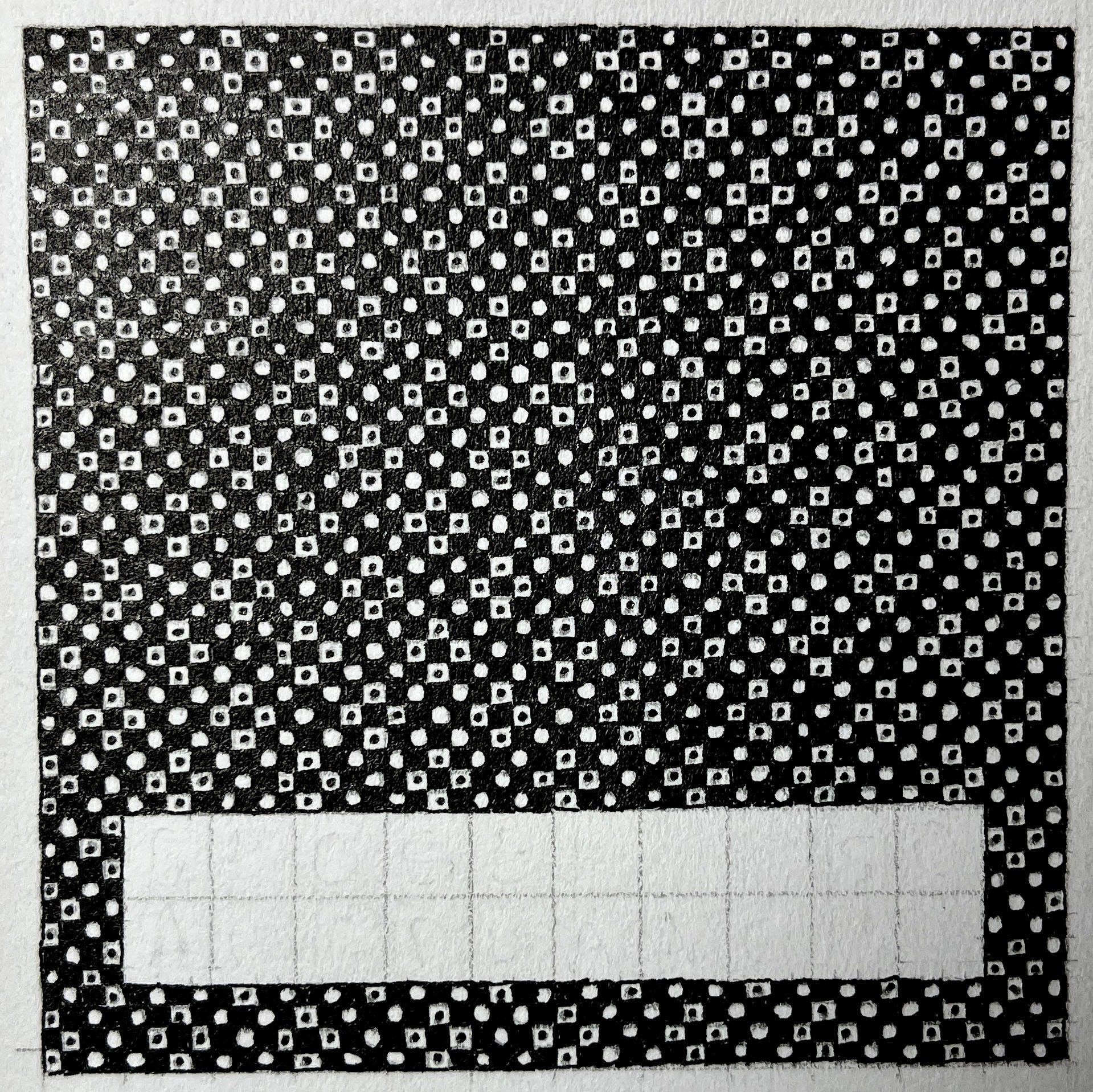
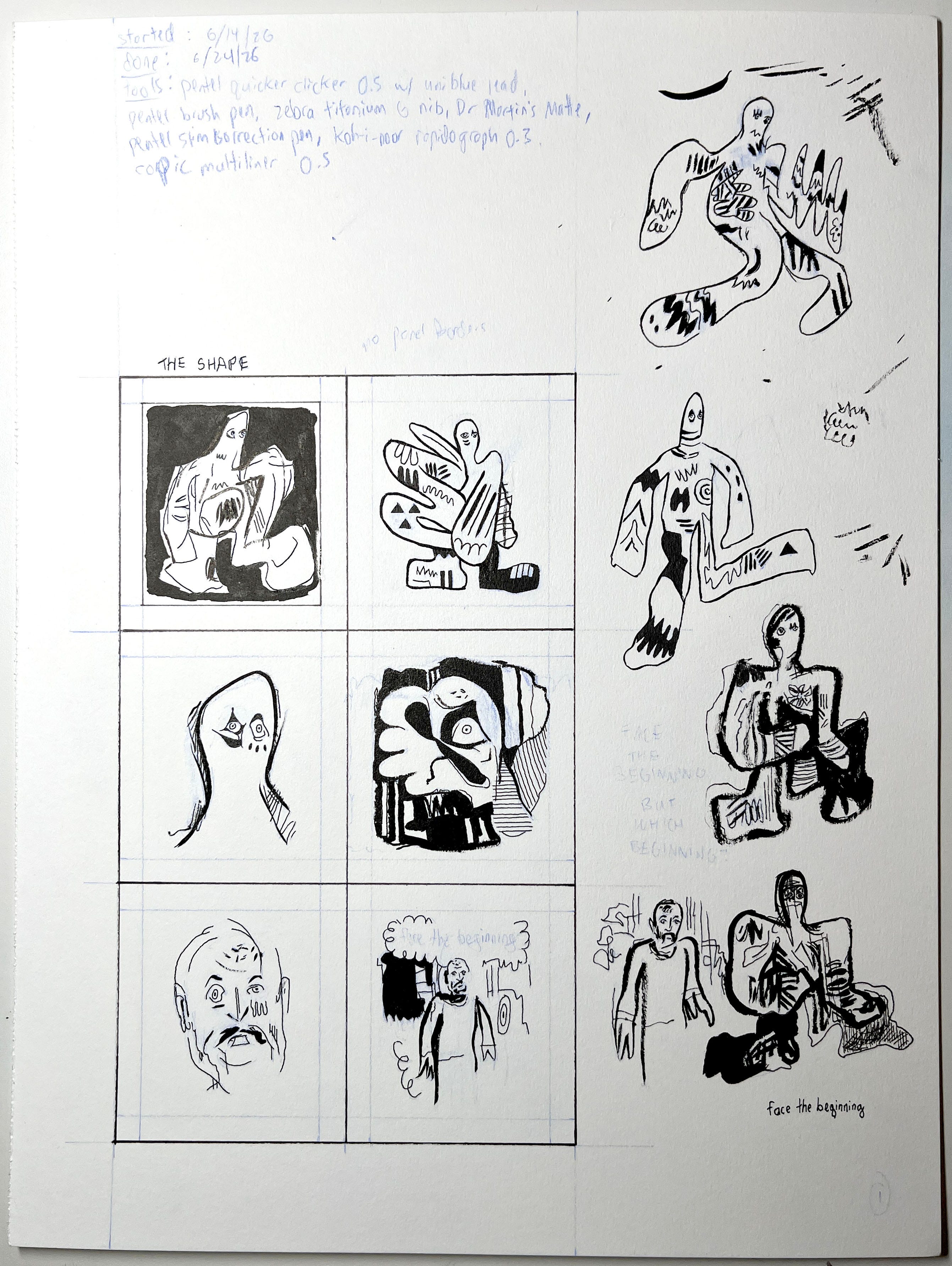
arbitrary that words are this other thing, when ultimately it’s all just a drawing, or, ha ha, in that case, a collage, some form of presenting an image in some way, it’s always an image, whether it’s, a letter-form or a tree or whatever. For a little while I was making these drawings where I would draw a dense pattern and then I would do this process of drawing on top of it and erasing it, and a lot of that was a way of making those lines muddy or making it
Katie
Yeah.
Jason
to where there was less of a distinction between objects or concepts, and it was just kind of this environment, like white noise,
Katie
Yeah.
Jason
and as a way to kind of questioning the idea of the distinction between different objects in an environment. Because, yeah, in comics, it’s so clear. If you look at Chris Ware or Ivan Brunetti or something like that, the, forms are, or Ernie Bushmiller, forms are very separate from each other and they’re very specific and clear, they’re all, it’s almost like a pictogram, like drawing
Katie
Yeah.
Jason
as language or something like that.
Katie
Yeah, I guess I’d be interested to, just because we’re different, we’re different ages, and
Jason
Yeah.
Katie
I think we have different reference points
Jason
Yeah.
Katie
what work was really the work that you were like “I am in this”, or, you know, I feel like we all make choices to be a part of
Jason
Yep.
Katie
someone’s visual world or something like that. What choices were you making when you were starting or throughout?
Jason
Yeah. When I was little I read superhero comics, and then when I was a teenager, I got into things like Eightball or Love and Rockets or Robert Crumb, and I worked in a comic book store when I was in high school. I really was too inept and not confident enough to make comics. I went to art school, and I think things that were happening around that time were still things like Dan Clowes or Chester Brown or the
Katie
Yeah.
Jason
Hernandez Brothers, Chris Ware. Chris Ware went to the college I went to, and I had professors that would like reference him, and so he was really, really big at that time, but I couldn’t make comics, anything I made was just really, really bad. And then I got a little bit bored of comics
Katie
Yeah.
Jason
for me Chris Ware is not super interesting, a lot of the things that were happening around, you know, late 90s, early 2000s weren’t as interesting as when I first saw Julie Doucet or Chester Brown or something like that, which was really, really exciting to me when I was a teenager, but around
Katie
Yeah.
Jason
2000, it just felt like everyone was doing kind of the same stuff and it was really boring and I just was losing interest. And then Fort Thunder became kind of a big thing.
Katie
Yeah.
Jason
and so I started to see that stuff. And that was just a completely different way of thinking about comics. Like before that
Katie
Yeah, for sure
Jason
it was like everything probably kind of came from Crumb, and maybe from Kurtzman, I don’t know, probably from Crumb.
Katie
Yeah
Jason
It was, like, white dude who has some affinity for cross-hatching, who is misanthropic, and has a negative worldview, all fantasy or superhero things are bad, and I don’t know. That was just the general hegemony of comics
Katie
Yeah.
Jason
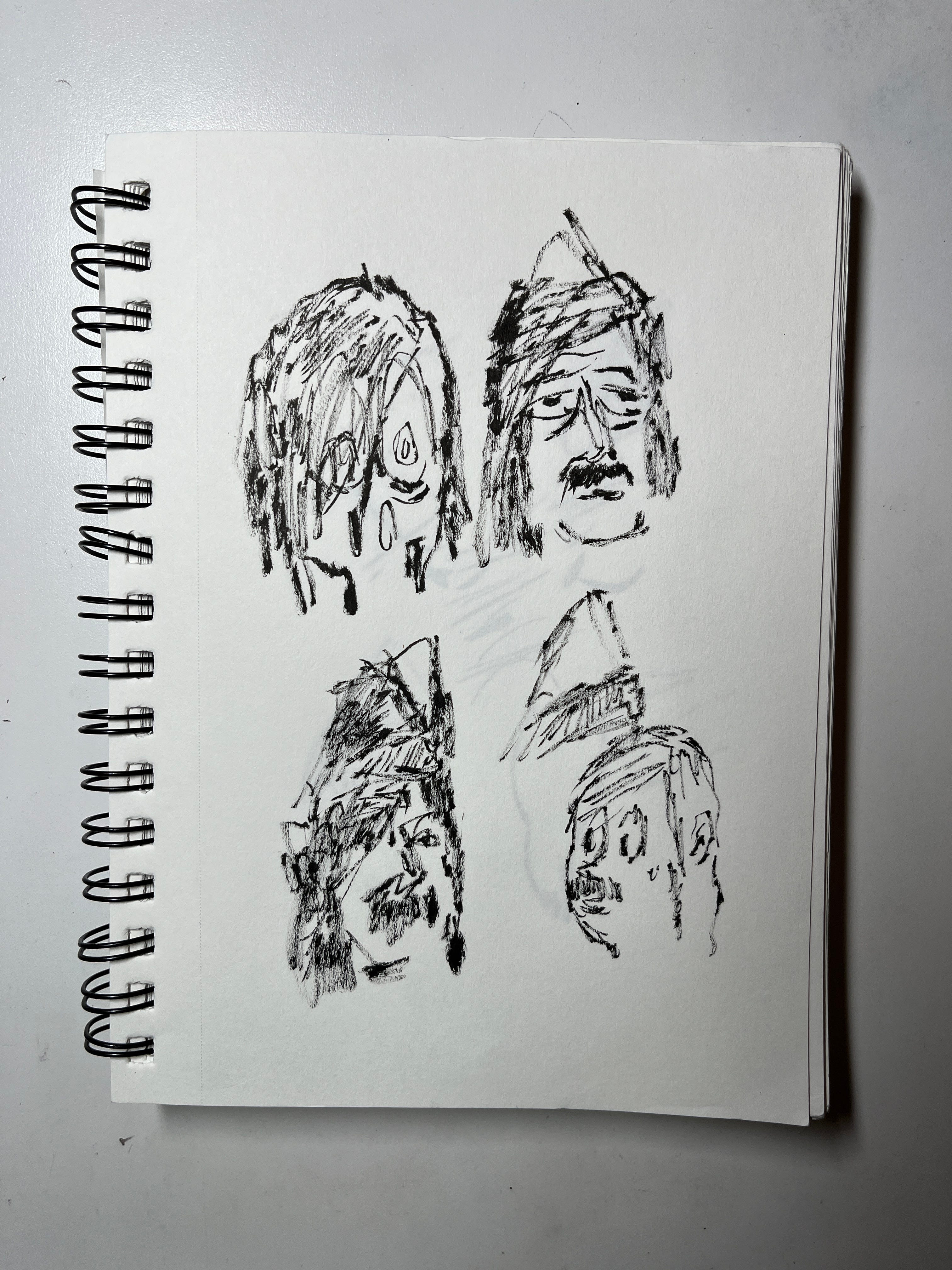
at that time. And then Fort Thunder came out and it was completely wild, really interesting mark-making, people who had different reference points visually from the past. Gary Panter became a really big
Katie
Yeah.
Jason
thing. People who are into noise music and things like that. And so that became really, really exciting. And I think that was the thing, it was that and a combination of being really high-energy and really obsessive but also lo-fi,
Katie
Yeah.
Jason
and maybe the kind of like crumbier parts of Gary Panter, gave me more confidence and made me think that I could make stuff. And so when I was first starting to make comics, the first thing I did was this thing called Exploding Head Man, and that was super-influenced by Gary Panter, like the idea of having a character not have a specific style or a specific representation but changing that representation throughout, trying to do it in such a way that it was at least relatively clear what was happening. But I
Katie
Yeah.
Jason
think that, for me, getting away from this really rigid, more constipated way of creating comics and images where you had this plan and you drew everything the same and it was very process-oriented, being able to get away from that was really exciting and allowed me to make stuff.
Katie
Yeah.
Jason
How about you?
Katie
I also grew up reading superhero comics so that was my earliest reference point for, and I mean, I was reading superhero comics in this way that was very, I was like really obsessive about it.
Jason
Yeah.
Katie
I was really up on every, I was up on a lot of stuff. I mean, when I was a teenager, or when I was just starting to become a teenager we could read anything on the internet.
Jason
Right.
Katie
Basically, so I didn’t have to buy comics ever. Really.
Jason
Super-interesting.
Katie
When I was really young, my grandma had this huge comic collection because she was just kind of a hoarder
Jason
Mm-hmm.
Katie
and she was interested in the speculator boom in the 90s,
Jason
Oh, yeah.
Katie
and since she had all these Wizard magazines
Jason
Mm-hmm.
Katie
and all these, you know, like every Todd McFarlane comic
Jason
Mm-hmm.
Katie
and that kind of stuff, which, I would flip through those and I would read them kind of, but I don’t really remember any of them, you know?
Jason
Yeah.
Katie
In this way, there’s just like kind of visual information that washed over me but then, yeah, when I was in middle school I could just read comics on my computer like constantly.
Jason
Yeah.
Katie
And it was like post-2000s Marvel/DC. So it was just a lot of Grant Morrison,
Jason
Yeah.
Katie
a lot of like Ultimate, the Ultimate line,
Jason
Mm-hmm.
Katie
which was very like youth culture at the time, very Iraq war, Bush type stuff.
Jason
Mm-hmm.
Katie
And then whatever, I kind of just kept reading comics and I, actually, when I was younger, I wanted to write. I wanted to write superhero comics,
Jason
Oh, wow. Uh-huh.
Katie
that was what I ultimately wanted from comic books, is that like I wanted to be like Jamie Delano or something, you know, like I like wanted that kind of life of a script writer.
Jason
Mm-hmm. Right.
Katie
Because I didn’t think I could draw. I didn’t know that drawing was a skill that you could acquire.
Jason
Right.
Katie
At all. I thought it was just like, you know, I grew up in South Carolina, and it’s not a very like open place
Jason
Right.
Katie
in an artistic way, like being really into art is kind of like, you have an ability before, and then you just kind of, it just flows through you
Jason
Totally.
Katie
that’s how they think about it,
Jason
Yeah.
Katie
that they don’t really see it as a thing that you can nurture, foster, be better at or whatever.
Jason
It’s not a growth mindset part of the country.
Katie
Yeah, it’s kind of like you’re born a certain way, and then you die a certain way,
Jason
Yep.
Katie
and what happens in between that is just like a matter of you living through whatever you were given. And I don’t know. So like, whatever, and then I went to college, and that kind of turned into me getting into Love and rockets and like reading Eightball on my computer, like I was really disconnected from anything that anyone was making currently
Jason
Yeah.
Katie
when I was in college because I was, I just never grew up in a metropolitan area, like I had never
Jason
Yeah. Right.
Katie
been around an art culture. And then, but it was crazy, it was just kind of instant. I started working at a comic book store when I moved to New York, and that was where a lot of my, I just had to learn about, I don’t know, I guess it was a little bit before that, I started learning about stuff, but I was just, I just kind of was really abreast on everything that was being published by a publisher.
Jason
Yeah.
Katie
In this way, I got really nerdy and obsessive about, like, okay, I need to know everything about comics,
Jason
Yep.
Katie
because I just need to this to be my life or something.
Jason
Yeah.
Katie
And then the short, then it just gets really like, you know, when I just was graduating college, it was right when Lale Westvind was really on the scene and
Jason
Yep.
Katie
so was like, Connor Willumsen... Like the generation kind of immediately after, or not generation, but the people immediately after the 2dcloud kind of stuff.
Jason
Yep, yep.
Katie
Um, so like that, like Tommi Parrish.
Jason
I don’t know, Tommi Parrish.
Katie
Yeah, they have a book called, they have a big 2 books from Fantagraphics that are really good. But also Antoine Cossé was really big. There was a lot of European stuff was coming, because Breakdown Press existed at this time, too.
Jason
Yeah.
Katie
For me, it was like, this is all stuff that I’m sure you’re aware of, but it was just like stuff I was, you know, my really open, how do I make comic images thing kind of came from, you know, like the stuff that Breakdown was putting out and then also old PictureBox stuff,
Jason
Yeah.
Katie
like all kinds of weird PictureBox floating. Like things where people would be like, oh, we found five million copies of Cola Madnes,
Jason
Yeah.
Katie
and we’re selling these for $5, they’re like, well, I guess I got to buy Cola
Jason
Totally.
Katie
Madnes, you know, like that kind of thing, and specifically got really into people who made images that were more on the abstract side
Jason
Yeah, yeah.
Katie
of comics because I think I knew that I couldn’t produce. Even if I started making... Well, I was making this collage comic at the same time. I was making all these digital images.
Jason
Yeah.
Katie
And so I was really into the idea of like flatness in images, just like the lack of the ability to perceive distance
Jason
Yep.
Katie
or depth, became really important to me. So flatness was one of my favorite traits in an artist or something. So I got really into like, Michael Comueau.
Jason
I don’t know that person. How do you... Oh, is it C-O-M-E-A-U?
Katie
Yeah.
Jason
I don’t know if I know him.
Katie
He’s a Canadian guy. He did a book with Koyama called Winter’s Cosmos.
Jason
Oh, interesting. I like these drawings. Yeah, they’re cool.
Katie
Yeah, they’re really cool. And he just had a few different collage zines that I found at various places around the city. Because then I lived in New York so I could just go to a comic book store and people drop things off and they don’t sell, actually, usually, you know, not to be weird, not to be discouraging, but it’s like, you will go, I will go through a big box of zine stuff, and I’ll be like, oh, fuck, why do they have this weird anthology that I know half the people are in this or something like that.
Jason
Right.
Katie
Yeah. Kind of that stuff, like Mirror Mirror,
Jason
Yep.
Katie
that was big for me. And at the same time Gekiga manga became really popular in the United States, like in a publishing sense.
Jason
Yeah.
Katie
So I was reading a lot of like Tsuge,
Jason
Yeah, Tatsumi.
Katie
and Seiichi Hayashi and stuff like that.
Jason
Yep.
Katie
Yeah, just like the shit that Ryan Holmberg translates basically
Jason
Yeah.
Katie
became really immediately huge in my imagination. This is kind of before I became peers with anyone though.
Jason
Yeah.
Katie
You know what I mean?
Jason
Yeah.
Katie
And then in the 2020s, it became really different because I was actually in a comic scene where I was making comics and everybody else was making comics too. And that’s when I met Angela. And Max Huffman and Floyd Tangeman, Sarah Kirby, Mikael Choukroun, like all these people who were, and Juliette Collet, people who were in their 20s who were living in New York and they were just doing events all the fucking time.
Jason
Yep.
Katie
So they would just be like, releases, comics would come out and they would have a party, or my girlfriend, primarily, ran this figure drawing thing where we would just draw each other and then all these cartoonists would come.
Jason
Yep.
Katie
So it was just kind of this like soup of like hanging out with people. And so it was easy to be like, oh, I’m going to make a comic so I can hang out with these people that I caught.
Jason
Yep.
Katie
For me, it became a very social thing pretty quickly. I don’t know.
Jason
Yeah.
Katie
That’s kind of the story. I also have the same reverence for the stuff that you’re talking about. You know, I love Chester Brown.
Jason
Yeah, Chester Brown’s my favorite.
Katie
Yeah, Chester Brown is amazing.
Jason
I keep wanting to send him zines that I make because like he has his Patreon, and I was subscribing and he’ll just send comics and it’s the coolest thing to get something from Chester Brown.
Katie
Yeah.
Jason
So I grew up in Texas, went to college in Austin, moved to San Diego, was making comics when I lived in San Diego, didn’t really know anybody at all who made comics apart from, well, I did randomly... There was a guy named Alvin Buenaventura who was
Katie
Yeah.
Jason
kind of associated with PictureBox at one point, but he printed Kramer’s Ergot 7, the really big one, and
Katie
Yeah.
Jason
he was randomly in a band with someone that my girlfriend knew at the time, completely unrelated to comics. But so I was kind of friends with him. But then I moved from San Diego to Portland. I didn’t know anybody here making comics. And then after I started making comics. I met a few people, and I don’t even remember how I met Blaise. I think Blaise sent me an email, you know, and we just started emailing each other.
Katie
Yeah, classic.
Jason
Yeah, exactly.
Katie
That’s how I met Blaise.
Jason
That totally makes sense, especially at the time. And then he moved here and he was at one point living in a house or an apartment with Austin English and Jesse McManus, it was like one summer, and we would hang out sometimes. There was also a guy named Dylan Williams who has since passed.
Katie
Yeah.
Jason
He was really awesome. He and Tim Goodyear had this store called The Bad Apple, and so we would go there for drawing nights sometimes. Aidan Koch worked at... I worked for this coffee company called Stumptown in
Katie
Yeah.
Jason
a cafe that was in a hotel, the Ace Hotel, and Aidan worked at the front desk of the hotel.
Katie
Oh, wow.
